Belly fat after 50 is not simply a cosmetic problem, and it is not simply a matter of doing more sit-ups. Visceral fat — the fat stored deep in the abdominal cavity around the organs — is metabolically active and carries real health implications. Shifting it requires a specific approach. This article covers both sides of that: the training that works, and the nutrition without which the training won't be enough.
Why Belly Fat Is Different After 50
The fat that accumulates around the middle after 50 doesn't behave the same way as the fat you might have lost in your 30s by cutting back for a few weeks. Hormonal changes play a significant role. Falling oestrogen in women causes fat distribution to shift from the hips and thighs toward the abdomen. Declining testosterone in men has a similar effect, reducing the body's ability to build and maintain muscle while making fat storage easier. The result, for both sexes, is a body that is increasingly inclined to store fat centrally and increasingly resistant to giving it up.
Muscle mass also declines with age — a process we've covered in our beginner's guide to weight training over 50 — and less muscle means a slower resting metabolism. The body simply burns fewer calories at rest than it used to, and the dietary habits that were manageable at 35 stop working at 55.
Then there's cortisol. The stress hormone doesn't just make you feel wound up — it directly promotes visceral fat storage, particularly around the abdomen. Adults over 50 tend to have higher baseline cortisol levels, and chronic stress compounds this further. Understanding why the fat is there in the first place makes the strategy for removing it much clearer.
The Truth About Exercise and Belly Fat
Exercise is essential. But you cannot out-train a bad diet — and after 50, that statement is more true than it has ever been. The body is simply too efficient at compensating. An hour of hard training burns a few hundred calories. A couple of biscuits, a sugary coffee and a few crackers in the evening puts them straight back. If your nutrition is keeping blood sugar elevated and the body in fat-storage mode for most of the day, no amount of training will produce the results you're looking for.
This doesn't mean the exercise doesn't matter. It means the exercise and the nutrition have to work together. Get both right and the results come. Get only one right and progress stalls.
Forget Crunches — Here's What Actually Works
One of the most persistent myths in fitness is spot reduction — the idea that doing exercises for a specific body part will burn fat in that area. It doesn't work. A thousand crunches will strengthen the abdominal muscles underneath the fat, but they won't burn the fat itself. What burns fat is reducing total body fat through the right training stimulus and a supporting nutrition strategy. When overall body fat comes down, the belly follows.
Compound Strength Training
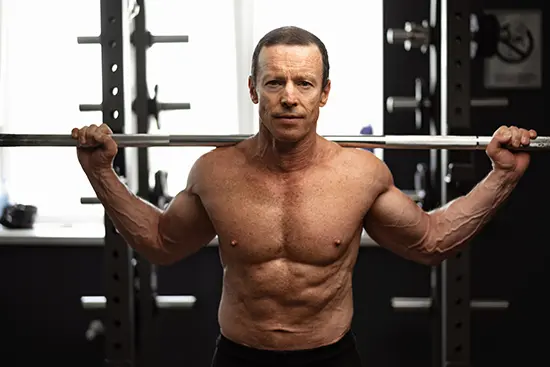
Compound exercises — squats, deadlifts, presses, rows — are the single most effective training tool for fat loss after 50. They work multiple large muscle groups simultaneously, creating a high metabolic demand both during and after the session. The after-burn effect — technically called excess post-exercise oxygen consumption — means the body continues burning calories at an elevated rate for hours after a strength session. Steady-state cardio produces a fraction of this effect.
Building muscle through compound training also raises your resting metabolic rate permanently. Every additional kilogram of muscle you carry burns more calories at rest. This is the compounding benefit that makes strength training the foundation of any serious fat loss strategy after 50 — not just a supplement to cardio, but the primary tool.
High-Intensity Interval Training
HIIT — short bursts of high-intensity effort followed by brief recovery periods — has strong research support for visceral fat reduction specifically. A 2012 study comparing resistance training, aerobic training and a combination found that resistance training combined with intervals was significantly more effective at reducing abdominal fat than aerobic training alone.
For adults over 50, HIIT doesn't need to mean sprinting until you collapse. It means working hard for 20–40 seconds, recovering for 40–60 seconds, and repeating. Kettlebell swings, cycling, rowing, battle ropes, or simply alternating between fast and slow walking on an incline all qualify. Two HIIT sessions per week alongside two to three strength sessions is a highly effective combination.
Why Steady-State Cardio Alone Won't Cut It
Long, slow cardio — the 45-minute jog, the hour on the cross-trainer — has its place in overall health and cardiovascular fitness. But as a fat loss strategy after 50, it consistently underdelivers. The body adapts quickly to steady-state cardio, the calorie burn is modest, and it does nothing to address the muscle mass decline that is slowing your metabolism in the first place. If cardio is your primary tool, you're working against a significant disadvantage.
Use it as a supplement — a 30-minute walk is genuinely useful, particularly after meals for blood sugar management — but build your programme around compound lifting and intervals first.
"The goal is not to burn as many calories as possible during training. The goal is to change the body's composition so that it burns more at rest — every hour of every day."
The Nutrition Side — Where Most People Go Wrong
Training creates the conditions for fat loss. Nutrition determines whether it actually happens.
You Can't Out-Train a Blood Sugar Spike
Every time you eat carbohydrates — particularly refined ones like bread, pasta, rice, biscuits, cereals and sugary drinks — blood glucose rises and the pancreas releases insulin to deal with it. Insulin is a storage hormone. While insulin is elevated, the body is in fat-storage mode, not fat-burning mode. If you are eating every two to three hours, grazing on snacks throughout the day, and regularly spiking blood sugar with high-carb foods, your body is almost never in a position to access stored fat for energy. It doesn't matter how many hours you've spent in the gym.
The practical fix is not necessarily a strict low-carb diet — though for some people that is exactly what works. It's about controlling the quality and quantity of carbohydrates, spacing meals further apart to allow insulin to drop between them, and replacing refined carbs with higher-fibre, lower-glycaemic options that produce a slower, more manageable blood sugar response.
Protein at Every Meal
Protein is the most important macronutrient for fat loss after 50, for several reasons. It has the highest thermic effect of any food — the body burns more calories digesting protein than it does digesting carbohydrates or fat. It is the most satiating macronutrient, meaning it keeps you fuller for longer and reduces the drive to snack between meals. It preserves muscle mass during a calorie deficit, which matters enormously when muscle is already declining with age. And it stabilises blood sugar when eaten alongside carbohydrates, blunting the insulin spike.
The target for adults over 50 who are training is roughly 1.6 to 2.2 grams of protein per kilogram of bodyweight per day. For a 75 kg person that's 120–165g of protein daily. It sounds like a lot until you build the habit of including a meaningful source at every meal — eggs, meat, fish, Greek yoghurt, cottage cheese, legumes. Start there before thinking about supplements.
The Constant Snacking Problem
Modern food culture has normalised eating every two to three hours — a pattern that is actively counterproductive for fat loss after 50. Every snack, however small, triggers an insulin response. If insulin is constantly elevated because there is never a meaningful gap between eating occasions, the body never gets the signal to start burning stored fat. It has no reason to.
Three solid meals with adequate protein, spaced four to five hours apart, will produce better fat loss results for most people than six smaller meals throughout the day. The goal is to eat well when you eat, and then stop — giving the body time to actually use what it has stored. This is the basic principle behind time-restricted eating, which has solid research support for visceral fat reduction specifically.
Cortisol, Stress and Belly Fat
Cortisol, the body's primary stress hormone, directly promotes fat storage in the abdominal region. This is not metaphorical — it is a documented physiological mechanism. Chronically elevated cortisol increases appetite, drives cravings for high-calorie foods, disrupts sleep, and signals the body to hold onto fat stores, particularly viscerally. Adults over 50 already tend to have higher baseline cortisol than younger people, and chronic work stress, poor sleep or overtraining compounds this further.
The training implications are real: more is not always better. Overtraining without adequate recovery raises cortisol and can actually work against fat loss. Two to three strength sessions and two interval sessions per week, with genuine rest days, is more effective than training every day at moderate intensity.
Sleep — The Overlooked Factor
Poor sleep is one of the most reliably effective ways to stall fat loss, and it is almost never mentioned in fitness content. Sleep deprivation raises cortisol, elevates ghrelin (the hunger hormone that drives appetite), suppresses leptin (the satiety hormone that signals fullness), and impairs insulin sensitivity — creating a perfect hormonal environment for fat storage and overeating. Research has consistently found that adults sleeping less than six hours per night have significantly higher rates of obesity and abdominal fat than those sleeping seven to nine hours.
If you are training consistently, eating well and still not seeing results, sleep is the first place to look. Seven to nine hours of good-quality sleep is not a luxury — it is a metabolic necessity.
Alcohol — An Honest Conversation
Alcohol deserves a plain mention here, because it has a specific and significant effect on fat metabolism that most people are not aware of. When alcohol is present in the body, the liver treats it as a toxin and prioritises metabolising it above everything else — including burning fat. Fat oxidation effectively pauses for the duration, which can be several hours depending on intake. Add the empty calories, the blood sugar disruption, the disrupted sleep quality and the increased appetite and poor food choices that typically follow a few drinks, and regular alcohol consumption is one of the more effective ways to maintain belly fat regardless of how well you're training.
This isn't a call for total abstinence. It's an honest picture of the mechanism so you can make an informed choice about how it fits into your approach.
Putting It Together — A Practical Weekly Framework
Fat loss after 50 is not complicated, but it does require both sides of the equation to be working simultaneously. A structure that delivers:
- 2–3 compound strength sessions per week — squats, deadlifts, presses, rows. Heavy enough to challenge you, with progressive overload over time.
- 1–2 HIIT or circuit sessions per week — 20–30 minutes is enough. Work hard, rest briefly, repeat.
- Daily walking — 7,000–10,000 steps. Low-intensity movement keeps the metabolism ticking, supports recovery and has a meaningful cumulative effect on calorie balance.
- Protein at every meal — eggs, meat, fish, dairy. Make it the non-negotiable anchor of your nutrition.
- Reduce refined carbs — bread, pasta, rice, biscuits, sugary drinks. Replace with vegetables, legumes and whole foods where possible.
- Stop grazing — three meals, four to five hours apart. Let insulin drop between eating occasions.
- Prioritise sleep — seven to nine hours. Not negotiable if fat loss is the goal.
- Manage alcohol honestly — know what it costs you and decide accordingly.
None of this is extreme. None of it requires a perfect diet, a six-day training week or a level of discipline that is unsustainable. It requires consistency over weeks and months — and the understanding that the nutrition and the training are two parts of the same strategy, not alternatives to each other.
If you're ready to build the training side of this, start with the beginner's weight training guide and work up to the full weekly workout routine for men over 50 or the best workouts for women over 50.
Frequently Asked Questions
After 50, falling oestrogen and testosterone levels cause the body to redistribute fat toward the abdomen. Muscle mass declines, slowing metabolism. Cortisol — the stress hormone — rises more easily and directly promotes visceral fat storage. And years of dietary habits that were manageable at 35 simply stop working. The good news is that all of these factors can be addressed with the right combination of training and nutrition.
Not reliably. Exercise is essential, but you cannot out-train a diet that keeps blood sugar elevated and the body in fat-storage mode. The most effective approach combines compound strength training and interval work with a nutrition strategy that controls carbohydrates, prioritises protein and reduces the constant snacking that prevents the body from ever entering a fat-burning state.
No. Spot reduction — targeting fat loss in a specific area by exercising it — is a myth. Crunches strengthen the abdominal muscles underneath the fat but do not burn the fat itself. Total body fat reduction through compound training, intervals and nutrition is what reveals the muscle underneath.
Most research suggests a target of around 1.6 to 2.2 grams of protein per kilogram of bodyweight per day for adults over 50 who are training. The priority is to include a meaningful protein source at every meal — eggs, meat, fish, Greek yoghurt, cottage cheese — rather than relying on snacks or supplements to make up the numbers.
Yes, significantly. When alcohol is present the liver prioritises metabolising it above everything else, including burning fat — effectively pausing fat oxidation for several hours. Add the empty calories, blood sugar disruption, disrupted sleep and increased appetite that follows, and regular alcohol consumption is one of the more effective ways to stall fat loss after 50, regardless of how well you're training.
Unlimited Fitness Ireland
Ireland's fitness resource for the over 50s. We cover strength training, martial arts, motivation and nutrition — because your best training years might still be ahead of you. Age is not a factor.
Related Articles

Sources & Further Reading
Després, J.P. (2012). Visceral Fat and Cardiovascular Risk in the Metabolic Syndrome. Current Atherosclerosis Reports. View on PubMed ↗
Willis, L.H., et al. (2012). Effects of Aerobic and/or Resistance Training on Body Mass and Fat Mass in Overweight or Obese Adults. Journal of Applied Physiology. View on PubMed ↗
Cappuccio, F.P., et al. (2008). Meta-Analysis of Short Sleep Duration and Obesity in Children and Adults. Sleep. View on PubMed ↗
Stokes, T., et al. (2018). Recent Perspectives Regarding the Role of Dietary Protein for the Promotion of Muscle Hypertrophy with Resistance Exercise Training. Nutrients. View on PubMed ↗
Sominsky, L., & Spencer, S.J. (2014). Eating Behavior and Stress: A Pathway to Obesity. Frontiers in Psychology. View on PubMed ↗